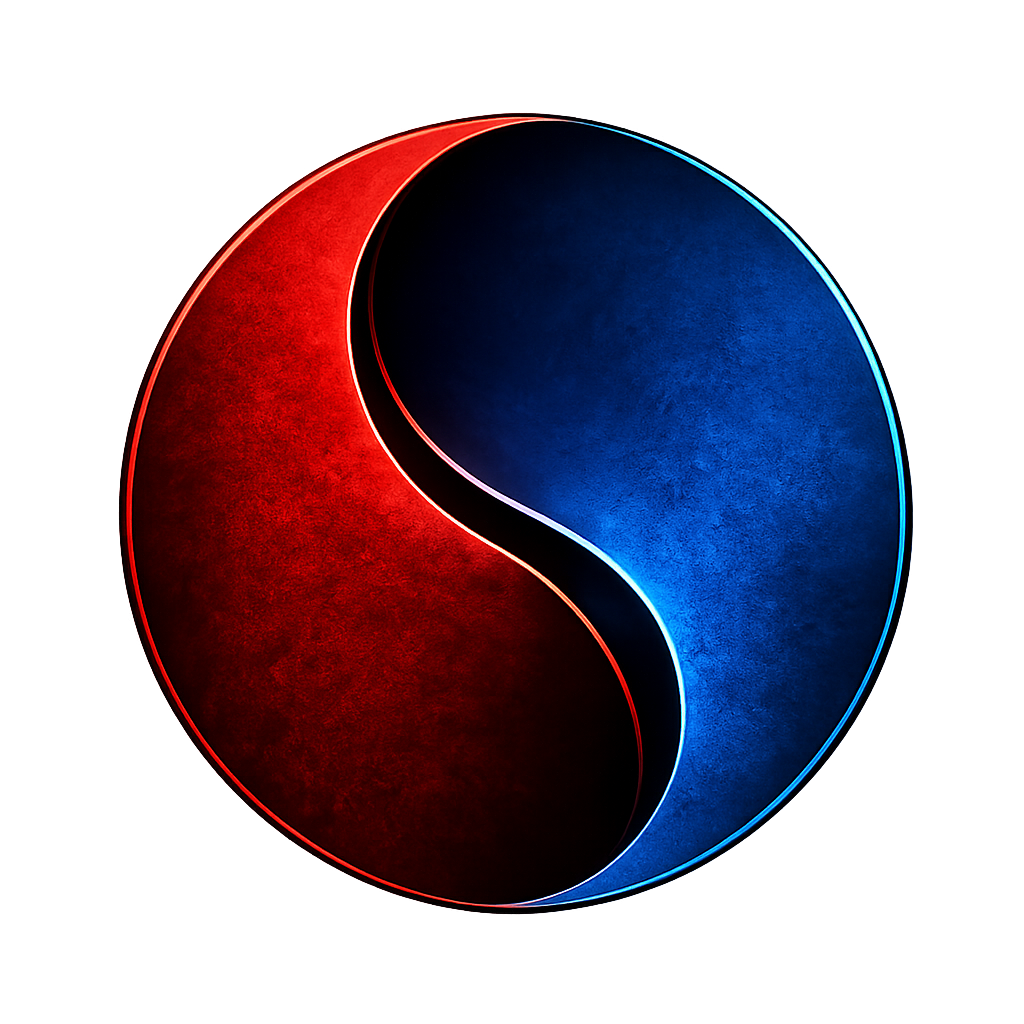

Yin Yang Meaning
The Taijitu carries information the pop interpretation skips. The dots, the curve, and the math underneath.
Yin yang meaning gets reduced in modern usage to "balance" or "opposites" the way astrology gets reduced to Sun signs. The actual Taoist framework is more specific. Yin and yang are not two enemies pinned against each other. They are two phases of one continuous motion, each containing the seed of its counterpart, each flowing into the other through a curve rather than a wall. Once you read the Taijitu on its own terms, the modern misuse becomes obvious. The symbol is a precise model. Most explanations of it are imprecise.
Yin Yang Meaning: How to Read the Taijitu
The Taijitu, the formal name of the yin yang symbol, is one of the oldest pieces of compressed information in human culture. Every line and dot in the design carries a specific meaning. Strip the symbol down and read it the way a Taoist sage would: not as "two halves" but as four design choices, each pointing at a different aspect of how polarity actually works. Get the four pieces, and the yin yang meaning lands clean.
The Chinese characters yin (陰) and yang (陽) originally referred to the shaded side of a hill and the sunny side of a hill. They were not abstract metaphysical categories. They were observations of how the same hill, the same mountain, the same field, presents two different faces simultaneously depending on where the sun is. Yin yang meaning begins as a concrete description of a real natural pattern, then expands outward to cover the structural logic that pattern follows everywhere.
Look at the Taijitu. The two halves are not divided by a straight line. They are divided by a flowing S-curve. This is the design choice that separates yin yang meaning from European dualism. A straight line says "here is one thing, there is the other, they are separated." The S-curve says "each half is flowing into the other, the boundary is in motion, the divide is not a wall." Yin yang is a dynamic, not a fixed split.
Inside the black half sits a small white dot. Inside the white half sits a small black dot. This is not decoration. It is the most important part of the Taijitu. The dots say: each half contains the seed of its opposite within itself. Pure yin already contains the beginning of yang. Pure yang already contains the beginning of yin. Nothing is ever purely one thing. The yin yang meaning that drops this detail loses the entire model.
The outer boundary of the symbol is a single unbroken circle. The two halves are not two separate objects. They are two phases of one object. The yin yang meaning hidden in the circle is that polarity is not the opposite of unity. Polarity is how unity manifests. Read the symbol from the outside in and the message is plain: one thing, expressing through two phases, each containing the other, flowing along a curve. The full model in four design choices.
Yin yang meaning is precise. The Taijitu is a model, not a mood board. Once you read the four design choices on their own terms, the symbol stops being a coffee-mug aesthetic and starts being what it actually is, which is a 3,000-year-old visual treatise on how complementary forces operate. The four design choices, each carrying Redacted, Chapter 19 in the original Daoist treatment, mirror sacred geometry traditions in Egypt and India that arrived at the same model under different names.
Duality vs Dualism: Yin and Yang Are Not Good vs Evil
Western philosophy has its own polarity tradition. It is called dualism. Dualism and yin yang share the observation that reality presents in pairs, but they part ways on what those pairs mean. Dualism turns the pair into a moral contest. Yin yang treats the pair as a complementary structure. The difference is not academic. It shapes everything from religion to politics to how you think about your own internal conflicts.
In Taoist thought, yin and yang need each other. Yang without yin is sterile. Yin without yang is stagnant. The pair is functional together, dysfunctional apart. Western dualism, especially in its Christian and Cartesian forms, treats the pair as a battle. Good versus evil. Mind versus matter. Spirit versus flesh. One side must win. The yin yang meaning is the opposite frame: one side must integrate with the other, or the system collapses.
Eastern frameworks generally read polarity as the natural structure of reality. Western frameworks generally read polarity as a problem to be resolved. Both observations are correct from inside their own assumptions, but they produce very different cultures. Yin yang meaning, taken seriously, produces a culture that emphasizes integration, timing, and harmony. Dualism, taken seriously, produces a culture that emphasizes victory, progress, and the elimination of the opposing pole.
The dualistic frame produces a specific kind of mistake. It tries to win against the opposite pole, and when that fails, it concludes the system is broken. The yin yang framework produces a different conclusion: the failure was not in the opposite pole, it was in the attempt to eliminate it. Nothing in this universe runs on pure yang. Nothing runs on pure yin. The named failure mode that creates the cycles of collapse dualistic civilizations keep repeating, Redacted, Chapter 19, is the same pattern visible in modern politics and ancient empire collapse alike.
Yin yang vs dualism is the most consequential philosophical fork in the road that civilizations choose, and most of them do not even realize they have chosen. The yin yang meaning preserved through Taoism, through the I Ching, through martial arts traditions, is the framework that civilizations seem to circle back to whenever the dualistic project hits its ceiling. We are in such a circling-back period now.
 View on Amazon
The Master Thyself Book
The full polarity model. And the trap of pretending to be above it.
What Does Yin Yang Mean Across Every Major Tradition?
If yin yang were a cultural quirk of one civilization, it would not show up everywhere else. It does. The complementary-polarity structure that Taoism preserved in the Taijitu appears across the major ancient traditions, sometimes with different symbolism but always with the same underlying logic. Three examples, three different continents, same model.
Egyptian cosmology was built on paired complementarity. Upper and Lower Egypt were always conceptualized as two halves of a whole. The goddess Ma'at represented the principle of balance between paired forces: order and chaos, truth and falsehood, light and shadow. Egyptian art ritually paired everything: the two scales of judgment, the two crowns, the two lands. The yin yang meaning under different names was operating in Egypt at least 2,000 years before Lao Tzu wrote it down.
The Pythagoreans, the secretive Greek school that gave us mathematics and music theory, structured their cosmology around paired principles. The Monad gave rise to the Dyad, the original split into two. Then came the Triad, the integration of the two by a third. The Pythagorean dyad mirrors yin yang almost exactly, including the insistence that the two are not enemies but functional pairs. Plato later inherited some of this and built his entire philosophy on paired distinctions, though dualism's later corruption flattened the original frame.
The Jewish mystical tradition known as Kabbalah maps reality on a structure called the Tree of Life. The Tree is built on two outer pillars, called Mercy and Severity, with a Middle Pillar of integration running between them. The pillars represent the same paired complementarity that yin yang describes: an expansive, giving, feminine principle, and a contracting, structuring, masculine principle. The Middle Pillar, identified in Kabbalah as Redacted, Chapter 20, is the integration line that mirrors the curve of the Taijitu.
Three traditions, three continents, three different vocabularies, one model. The simplest explanation is that yin yang meaning is not a Taoist invention. It is a description of how reality actually works, picked up independently by every serious tradition that paid careful attention. Taoism just produced the cleanest visual encoding of it.
For the masculine pole and the feminine pole specifically, see Divine Masculine and Divine Feminine. The yin yang frame is the umbrella structure under which both poles operate.
The Tao Te Ching: The Yin and Yang Operating Manual
If you want to understand yin yang meaning beyond the symbol, the primary source is the Tao Te Ching, a Chinese text attributed to Lao Tzu and dated to around 400 BCE. The book is short, 81 brief chapters, and it is essentially a working manual for living inside the yin yang framework. The translation challenge is real, but the core logic comes through in any decent rendering.
The Tao Te Ching is the foundational text of philosophical Taoism. It introduces the concept of the Tao (the Way) as the underlying reality from which the paired phenomena of yin and yang emerge. The text repeatedly emphasizes the futility of trying to hold one pole without its complement. It is not a religious text in the modern sense. It is closer to a philosophical operating manual, written in poetic compression.
Older than the Tao Te Ching, the I Ching or Book of Changes is a divination text that maps the interplay of yin and yang into 64 hexagrams. Each hexagram is a stack of six yin or yang lines, producing 64 distinct configurations that the text claims describe all possible situations in human life. The hexagram structure is the deepest mathematical encoding of yin yang meaning in any ancient text.
The Tao Te Ching uses a recurring phrase: "the ten thousand things." This refers to all the phenomena that arise from the basic interplay of yin and yang. The number ten thousand is metaphorical for "every distinguishable thing." The yin yang meaning at the cosmological level is that the entire universe of differentiated phenomena is the surface expression of Redacted, Chapter 19, the same one fundamental paired motion that Buddhist emptiness teaching and Hindu Purusha-Prakriti point at with different vocabulary.
"The ten thousand things carry yin on their backs and embrace yang. They achieve harmony by combining these forces."
Tao Te Ching, Chapter 42Chapter 42 of the Tao Te Ching is the most condensed statement of yin yang meaning in any classical source. Every thing carries both poles. Harmony comes from combining, not from eliminating. The corollary is direct. Any system, civilization, or person that tries to amputate one pole will produce instability. The original Taoist framework is plain about this. Modern thinkers keep rediscovering it under different names.
For the deeper sacred geometry that underlies the Taijitu and its cousins across traditions, see the foundational treatment at Christos Oil.
Yin yang meaning is not balance for its own sake. It is the recognition that the two halves require each other, and that any system pretending otherwise is on a clock.
The full structural breakdown, the operational implications, and the supporting evidence are covered in the book: Redacted, Chapter 19.
Master Thyself, Chapter 19Read Balance, Where Opposites Meet →Still with us?
Twelve more questions.
Each of these threads is traced to its source in the fuller investigation. If any of them pull, that is the door.
What if ...What if the original Chinese yin and yang just meant the shady side and sunny side of a hill, and everything else was elaboration?
What if the S-curve in the Taijitu is the entire difference between yin yang meaning and European dualism?
What if the two inner dots are the part most people skip, and the part that contains the actual model?
What if Egyptian Ma'at, Pythagorean dyad, and Kabbalistic two pillars are all the same model under different names?
What if Western dualism's biggest mistake was reading the two halves as enemies instead of complements?
What if every civilization that tries to amputate one pole produces a predictable collapse cycle?
What if Tao Te Ching Chapter 42 is the most condensed accurate statement of how reality actually works in any ancient text?
What if the I Ching's 64 hexagrams are a mathematical encoding of yin yang meaning that modern information theory has not yet caught up to?
What if the Pythagoreans knew this and Plato lost it on the translation?
What if the Kabbalistic Middle Pillar and the Taoist Tao are the same line of integration under different alphabets?
What if our current cultural moment is exactly the kind of moment in which civilizations rediscover yin yang meaning out of necessity?
What if reading the Taijitu correctly is one of the simplest acts of philosophical literacy a modern person can perform?