

Co-Created Reality
Not magical thinking. The actual mechanism by which attention, perception, and action shape the world that shows up.
Co-created reality is the recognition that you are not a passive observer of the world you live in. You participate in producing it. This is not a metaphysical claim. It is a documented finding in quantum physics, cognitive psychology, neuroscience, and decision theory, each working from different angles and arriving at compatible conclusions. The mainstream popularization, which calls this "manifestation" and reduces it to wish-fulfillment, has done a lot of damage by overpromising specific outcomes and underdelivering on the actual mechanism. The mechanism is real. The pop version is mostly false. The two are easy to confuse if you have only seen the pop version.
Co-Created Reality and Co Creation: It Is About Participation
The phrase "co-created reality" gets used in two very different ways. The popular version implies that you can think your way to material outcomes, which is mostly false and often harmful. The actual version, supported across multiple research disciplines, says something narrower and stranger: that the world you perceive is not separable from your act of perceiving it, and the world you act on is not separable from your acting on it. Four pieces clarify what is meant.
In quantum physics, the observer effect refers to the documented finding that the act of measuring certain particles changes their behavior. This is not a philosophical interpretation. It is a measurement result, repeated across thousands of experiments since the 1920s. What is observed depends on the act of observation. The popular leap to "consciousness creates reality" overshoots the physics. The narrow physics claim is more careful: at the quantum scale, there is no clean separation between observer and observed. Reality at that level is a co-participation, not a one-way street.
In psychology, expectancy effects are well documented. The placebo effect, where a sugar pill produces real physiological responses when the patient believes it is medicine, is one example. The Pygmalion effect, where teachers who expect students to perform well produce higher-performing students, is another. The nocebo effect, where negative expectation produces real harm, is a third. The pattern is consistent. Expectation reliably shapes outcomes in measurable ways, not through magic but through the way expectation channels attention and behavior. This is the operational layer of co-created reality.
Modern neuroscience has a finding called the reticular activating system: the brain has a filtering mechanism that decides which sensory inputs reach conscious awareness. The filter is shaped by what you are currently attending to. Buy a red car and you suddenly see red cars everywhere. This is not magic. The red cars were always there. Your filter changed. The frequency principle in co-created reality language is the same finding: what you tune your attention to, you start to see more of, which changes the world you experience, which changes the actions available to you.
The actual mechanism of co-created reality runs through documented findings in physics, psychology, and neuroscience. It is not wish-fulfillment. It is the cumulative effect of attention shaping perception, perception shaping interpretation, interpretation shaping action, and action shaping outcomes. The chain is mechanical. The misuse comes from skipping the middle steps and claiming that thoughts directly produce outcomes. They do not. Thoughts produce attention. Attention produces perception. Perception produces action. Action produces outcomes. The named discipline for running this chain consciously rather than reactively, Redacted, Chapter 7, is the distinguishing variable between people who participate in their reality and people who are subjected to it. The chain is what is real. The shortcut is what is false.
Co-created reality is real. The mechanism is documented. The popular shortcut version that promises material outcomes from positive thinking alone is not the same thing. Confusing the two has produced an entire industry of well-meaning practitioners who get poor results and then either blame themselves or quietly abandon the framework. The framework, used correctly, is robust. The shortcut version is what is broken.
Observer Effect Consciousness: The Chain of Attention, Perception, Action
Co-created reality has a specific mechanical chain. Each link in the chain is documented separately in mainstream cognitive science. The chain together produces the participatory effect, but only the chain together. Skipping any link breaks the mechanism. The chain has three links worth understanding individually.
What you pay attention to determines what your brain registers as present in your environment. Inattentional blindness, a well-documented phenomenon, shows that people miss obvious objects in their visual field if their attention is focused elsewhere. The famous "invisible gorilla" experiment is one of dozens demonstrating this. Your attention is not a passive flashlight scanning a fixed environment. It is the active selector that decides which pieces of the environment become real for you. Co-created reality begins here. You are already choosing which world is real to you by choosing what you attend to.
What you perceive then gets interpreted through your existing models. The same event registered by two different observers can produce two different interpretations, neither of which is "wrong" in the sense of misreading the data. Each interpretation is built from the perceiver's prior framework. The brain does not see raw reality. It sees reality already filtered through prior expectations and beliefs. This is not a bug. It is how perception works. Co-created reality's middle link is this interpretation layer: the meaning of what you see is being produced by you, not delivered from outside.
What you interpret then shapes what you do. If you interpret your colleague's comment as a personal attack, you respond defensively. The interrupt window between interpretation and action, Redacted, Chapter 7, is where the practice actually happens. If you interpret the same comment as a clumsy attempt at humor, you laugh. The two responses produce different downstream consequences. Your colleague responds differently. The relationship moves in a different direction. The outcome of the day is different. Multiply this across thousands of micro-interpretations per day across years, and the cumulative effect is enormous. Co-created reality's final link is action, and it is where the participation becomes outcome.
Three links. Attention, perception, action. The chain runs in that order, and the cumulative effect is the world you produce. This is the real mechanism of co-created reality. It does not promise outcomes. It explains how outcomes get shaped. Anyone who promises specific material outcomes from positive thinking has skipped the middle two links and is selling the first link as the whole chain. That is not how it works.
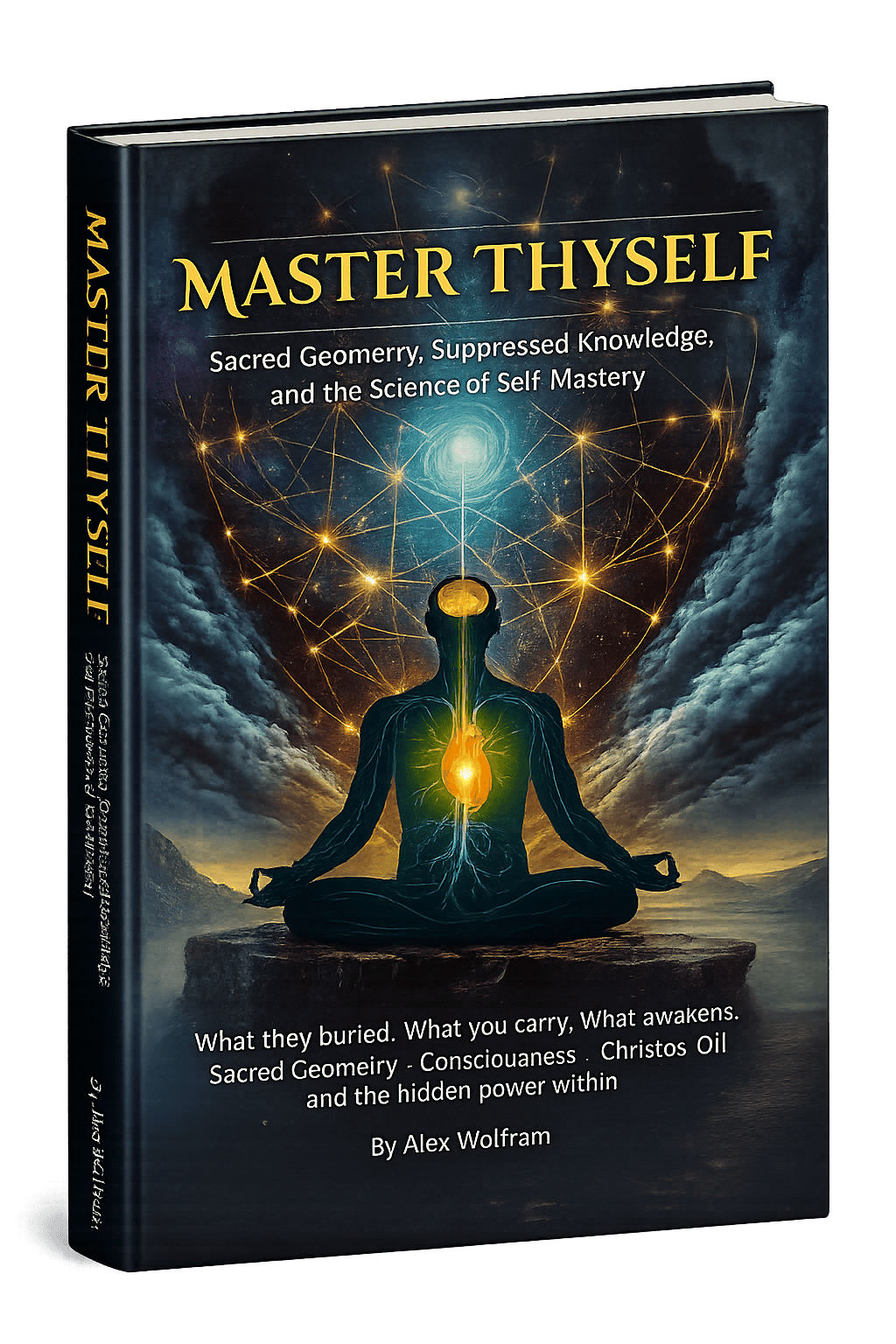 View on Amazon
The Master Thyself Book
The full participatory mechanism. Without the magical thinking.
Manifestation Reality vs Magic: Where Popularization Breaks Co-Creation
The pop version of co-created reality, often called manifestation or Law of Attraction, has produced specific dysfunctions that are worth naming. The framework itself is sound. The pop version's mistakes are predictable. Three traps are common enough to warrant explicit warning.
The pop framing tells you that thinking positively about money will bring money. Thinking positively about love will bring love. The mechanism described above shows why this is incomplete. Thinking shapes attention. Attention shapes perception. Perception shapes interpretation. Interpretation shapes action. Action shapes outcomes. The chain is necessary. The first link alone produces nothing. People who try to manifest through positive thinking and skip the action chain often produce zero results, then conclude either the framework is broken or they are. Neither is true. They are running half the chain.
If reality is co-created, the pop framing argues, then everyone is responsible for everything that happens to them. This collapses into one of the cruelest spiritual mistakes alive: telling cancer patients they manifested their illness, telling abuse victims they attracted their abusers, telling refugees they chose their displacement. This is the participatory framework misapplied. Co-created reality describes one's contribution to outcomes within the range of variables one actually controls. It does not erase external structural forces, historical violence, biological accident, or other people's free will. The victim-blame trap is a category error.
The most common trap is generalized magical thinking: the belief that intention alone produces outcomes without requiring concrete action. This is the inverse of the framework. Co-created reality describes how attention and action together shape outcomes, with the emphasis on the action half. Intention without action is fantasy. Action without intention is wandering. The framework requires both. The named ratio between them, Redacted, Chapter 7, is what every functional version of this practice includes and every dysfunctional version drops. The pop version usually sells the intention half alone, which is why its long-term track record is so poor compared to the framework when used correctly.
The three traps share one structural feature: they keep the comfortable parts of the framework (intention, attention, positivity) and remove the demanding parts (sustained action, integration of difficult feedback, willingness to be wrong about one's own interpretations). The popular version sells comfort. The actual framework requires participation, and participation includes the parts that are uncomfortable. The framework works. The shortcut does not.
For the deeper question of whether the underlying reality is something more like a simulation or a participatory medium, see the companion treatment at The Illusion. Co-created reality is the mechanism. The Illusion is the medium.
Participatory Universe: Consciousness Creates Reality, Physics Caught Up to the Mystics
The co-created reality framework is not new. Mystical traditions across cultures have insisted for millennia that consciousness and reality are entangled in ways that make the strict subject-object split untrue. Quantum physics arrived at compatible conclusions in the 20th century through entirely different methods. The convergence is worth taking seriously.
"Reality is not a collection of separate objects but rather a network of relationships. The observer is not separate from the observed."
David Bohm, theoretical physicist (paraphrased from Wholeness and the Implicate Order)David Bohm was one of the most respected theoretical physicists of the 20th century. Einstein called him his intellectual successor. Bohm's later work, particularly Wholeness and the Implicate Order, argued that the universe is better understood as an undivided wholeness than as a collection of independent parts. His framework anticipated by several decades what cognitive science later confirmed: that observer and observed are not cleanly separable. The mystical tradition's claim that consciousness participates in reality is no longer the fringe position it was 100 years ago.
Carl Jung's concept of synchronicity, where meaningful coincidences appear to bridge inner and outer events, sits in adjacent territory. So does the recent neuroscience of predictive processing, which models the brain not as a passive receiver of sensory data but as an active prediction machine that constantly tests its predictions against incoming data. All three frameworks (Bohm's physics, Jung's psychology, predictive processing in neuroscience) point in a similar direction. The bridge that ties them together at the operational layer, Redacted, Chapter 7, is what none of them name individually but all three imply. Reality is not happening to you. It is happening with you. You are a participant in the production of your own experience.
The corollary is direct. Once you accept that you are participating in producing your reality, the responsibility shifts. Not in the toxic victim-blame way the pop version teaches, but in the sober way that says: your attention is not free. Where you put it matters. Your interpretations are not neutral. The frames you reach for matter. Your actions, however small, accumulate. Co-created reality is a description of how the chain runs. The practice is learning to run the chain consciously instead of unconsciously.
Co-created reality is not the claim that thinking produces outcomes. It is the claim that attention, perception, and action accumulate, and that you are running this chain every day whether you know it or not.
The full structural breakdown, the operational implications, and the supporting evidence are covered in the book: Redacted, Chapter 7.
Master Thyself, Chapter 7Read Co-Created Reality →Still with us?
Twelve more questions.
Each of these threads is traced to its source in the fuller investigation. If any of them pull, that is the door.
What if ...What if the observer effect in quantum physics is the narrow physics version of what mystics have been saying for 3,000 years?
What if the placebo effect is the single most underrated piece of evidence for co-created reality in mainstream medicine?
What if the reticular activating system is the mechanical layer of the frequency principle?
What if the chain runs attention to perception to interpretation to action, and the pop version skips three of the four links?
What if "positive thinking will manifest money" is mathematically the same as buying a lottery ticket and calling it a financial plan?
What if the victim-blame trap is a category error, applying participation logic to forces that lie outside personal control?
What if David Bohm's implicate order anticipated 30 years of cognitive neuroscience?
What if Jung's synchronicity is the same phenomenon Bohm described, viewed from a different angle?
What if the predictive processing model of the brain is the most current scientific framework for understanding co-created reality?
What if your day-to-day micro-interpretations are accumulating into the life you have, one frame at a time?
What if the entire "manifestation" industry is selling the first link of the chain and pretending it is the whole chain?
What if running this chain consciously is the actual spiritual practice, and everything else is decoration?