
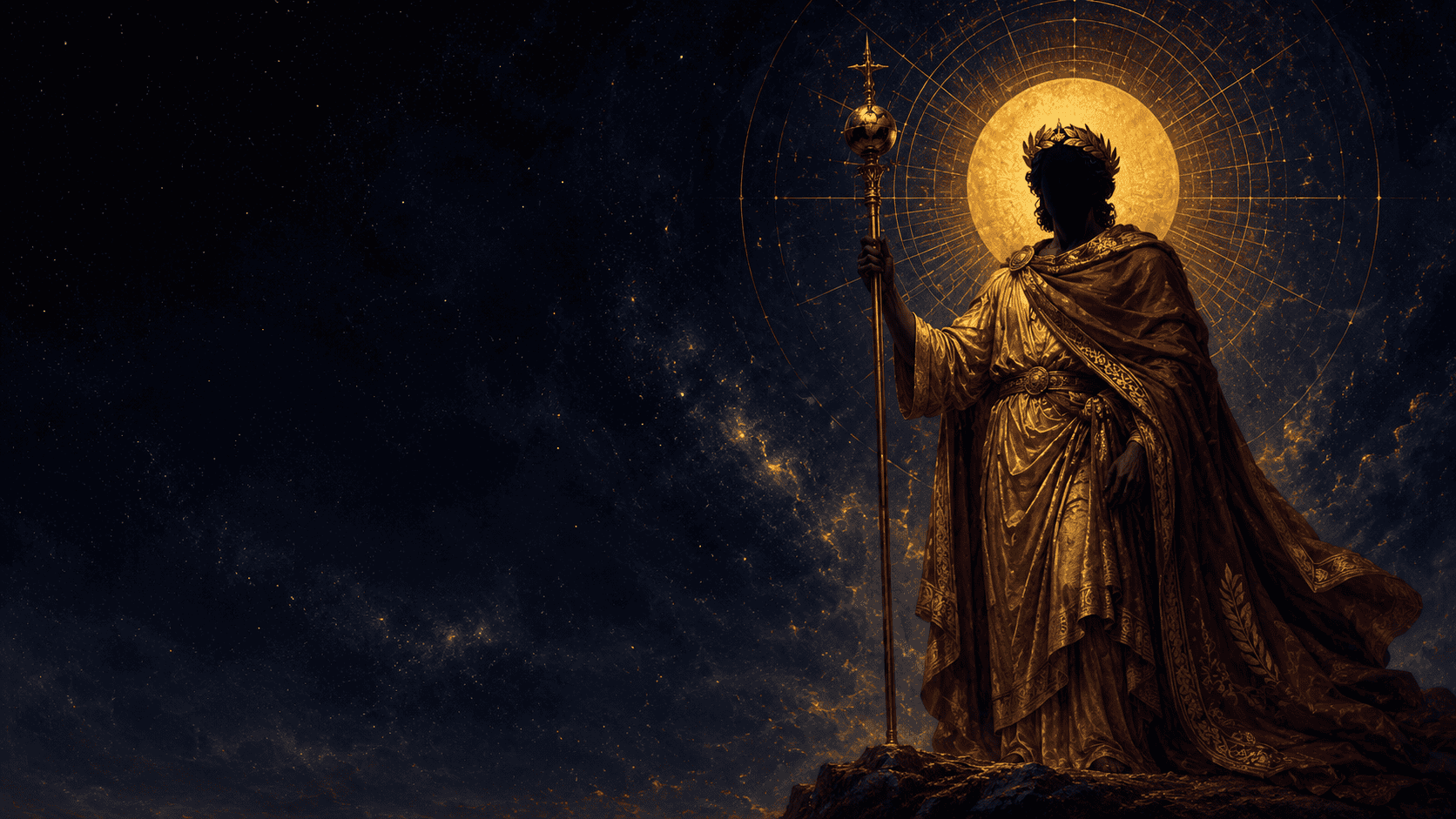
Divine Masculine
Not alpha culture. Not toxic masculinity. The Logos and the sacred king are operating on a different layer entirely.
The divine masculine is the active pole of the cosmic polarity, the complement to the divine feminine. The mainstream version of it has been flattened into either toxic dominance (alpha bro culture, conquest mindset) or apologetic absence (the soft, agreeable, conflict-avoidant modern man). Neither is the actual principle. The actual divine masculine is generative, protective, lawful, and sovereign. It shows up across traditions as Logos in Greek philosophy, the sacred king in ancient kingship rites, Yang in Taoism, and the warrior-poet-priest archetype that recurs across cultures. It lives inside everyone, regardless of sex. The work is to recover the principle from the distortions on both sides of it.
What Is the Divine Masculine? The Generative Pole, Not the Dominating One
The divine masculine, sometimes called sacred masculine, describes the active, projective, structuring pole of the cosmic polarity. Across the major traditions, it shows up as that which initiates, focuses, protects, builds, and bears responsibility. The modern conflation of divine masculine with aggression is a distortion. Aggression is what happens when the principle is corrupted. The principle itself is generative, not destructive. Four pieces clarify it.
In polarity language, the divine masculine is the principle of action, initiation, projection, and focused intention. Where the receptive pole holds space, the active pole moves into space. Where the receptive pole gestates, the active pole initiates. Where the receptive pole integrates, the active pole differentiates. This is not violence. Initiation without focus produces noise. Action without direction produces chaos. The divine masculine, when intact, is what makes coordinated movement possible. Without it, the receptive pole has nothing to receive.
The Greek word Logos, often translated as "word" or "reason," refers to the divine principle of order, meaning, and structured creation. Heraclitus introduced it as the universal pattern that organizes the cosmos. The Stoics expanded it. The Gospel of John famously opens with "In the beginning was the Logos." This is the divine masculine described in formal philosophical terms: the principle that brings form, distinction, and lawful order. The Logos is not aggressive. It is the source of the lawfulness that makes any coherent reality possible.
Across ancient cultures, the sacred king was the figure who held responsibility for the welfare of the realm by being in proper alignment with the divine masculine principle. Egyptian pharaohs, Mesopotamian kings, the Celtic high kings, the Hebrew sacred kingship preserved in David and Solomon. The sacred king did not rule through force. He ruled through alignment. His personal integrity directly produced the prosperity or collapse of the kingdom. The archetype is not historical fiction. It is a description of how the active pole, properly held, produces order rather than oppression.
In Chinese cosmology, yang is the active, bright, warm, projecting pole, paired with yin as the receptive, dark, cool, holding pole. Yang is not aggression. It is the masculine principle of movement and structured action. The yin yang model insists that yang requires yin to be functional, and that yang in isolation is sterile. The same insight runs through Logos, the sacred king, and every other intact divine masculine tradition. The structural feature that ties yang, Logos, and the sacred king into one operational principle, Redacted, Chapter 19, is what every functional masculinity tradition preserves and every distorted one drops.
The divine masculine is a structural principle. Aggression is not the principle. Aggression is what happens when the principle gets corrupted by ego, fear, or untreated wounds. Likewise, weakness is not the absence of the principle. Weakness is what happens when the principle gets suppressed out of guilt or apology. The actual divine masculine sits in between, generative and grounded.
Logos and the Sacred King Archetype: How the Sacred Masculine Got Flattened
If the divine masculine is a real structural principle, why is it almost impossible to talk about in modern culture without invoking either toxic masculinity or apologetic softness? The answer is historical. Three turning points in the last 200 years tracked the principle's progressive distortion. The pattern is documented.
In pre-industrial societies, the divine masculine was woven into daily life through rites of passage, apprenticeships, mentorship lineages, and embodied roles. Boys became men through structured initiation, usually in the presence of older men who had been initiated themselves. The principle was not theorized. It was transmitted directly through proximity and practice. The traditional forms had their own dysfunctions, but they preserved the divine masculine as a living transmission.
The industrial revolution pulled men out of their villages, out of mentorship lineages, and into factories. The transmission line of the divine masculine snapped. Fathers became absent. Older men stopped initiating younger men. The principle, deprived of its transmission, started collapsing into either workplace identity (you are what you produce) or military identity (you are what you can destroy). Both are corruptions of the divine masculine. Neither preserves the original generative function.
The post-1960s era produced two simultaneous distortions: the hyperaggressive alpha culture on one side (sales seminars, pickup artistry, dominance culture) and the apologetic deconstructed masculinity on the other (the man who apologizes for being male, who outsources his decision-making, who hesitates to lead). Neither is the divine masculine. Both are responses to the loss of the transmission. The cultural conversation about "what is a man" is happening in the absence of the principle, not the presence of it. The point at which the transmission broke, Redacted, Chapter 19, is more recent than most people assume, and naming it is the first step in recovering the principle.
The current revival of interest in the divine masculine is not nostalgia. It is the recognition that you cannot operate a functional culture without an active pole, and the active pole cannot be recovered by either dominating or apologizing. The recovery has to happen through restoring the actual principle, which means recovering the transmission lineage that was broken. The work is being done in small pockets, mostly outside institutional channels.
 View on Amazon
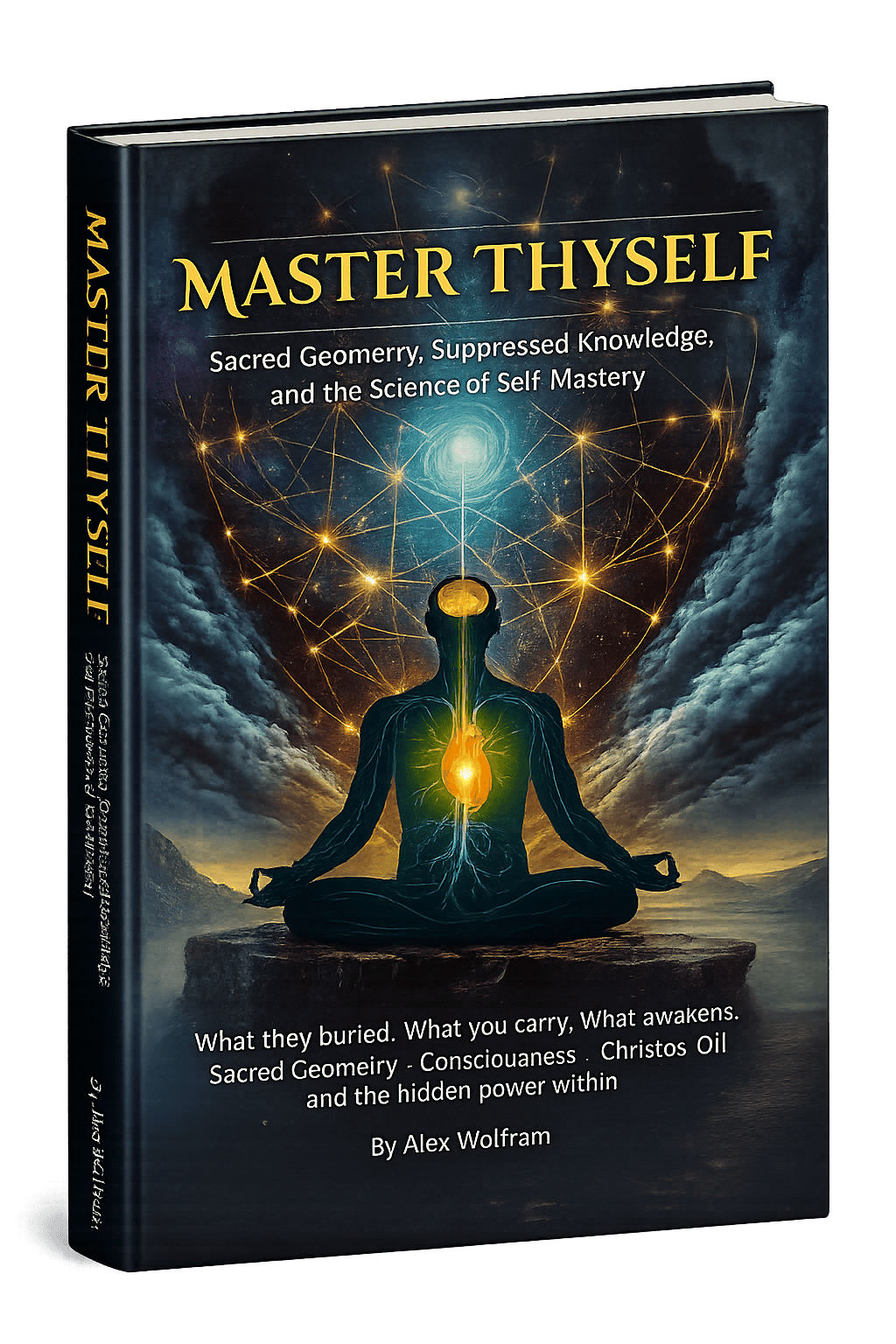
The Master Thyself Book
The active pole, recovered. The lineage, restored.
Divine Masculine Awakening: It Lives Inside Everyone, Regardless of Sex
The divine masculine is a structural principle, not a gender. Every person, regardless of biological sex, carries both poles. Women who deny the divine masculine inside themselves produce a specific dysfunction. Men who deny the divine feminine inside themselves produce a different one. The work is the same: integrate the pole that does not match your default identification, not amputate it.
Carl Jung used "animus" for the unconscious masculine in women, paralleling the anima as the unconscious feminine in men. His clinical observation was that women who deny their inner animus tend to project it outward, demanding that the men in their lives carry it for them. The integration work is universal. A woman with an integrated animus can initiate, set boundaries, make decisions, and hold structure without losing her connection to her feminine ground. This is not "acting masculine." It is recovering a part of the self that was disowned.
The divine masculine in any person shows up as the capacity for focused, directed intention. The ability to choose a target and move toward it without scattering. To say no to the things that are not your work. To carry the weight of a commitment without complaining. The receptive feminine pole holds space. The active masculine pole occupies space with focused purpose. Both are necessary. A person who has only the receptive pole becomes formless. A person who has only the active pole becomes brittle.
The actual question to ask, regardless of sex, is: where in your life are you trying to operate without the active pole? Where are you waiting for someone else to initiate what only you can initiate? Where are you holding without ever projecting? Where are you receiving but never giving? The divine masculine is what initiates, decides, and bears the weight of consequences. A life that has amputated this pole shows up as paralysis, perpetual victimhood, and an inability to commit. The restoration discipline, Redacted, Chapter 19, runs through embodiment rather than rhetoric, which is why men who try to fix this through podcasts and books alone almost always fail to restore it.
The divine masculine inside a woman is what lets her hold her own boundary, build her own work, lead when leadership is required. The divine masculine inside a man is what lets him stand inside his own choices without seeking validation, take responsibility without spiraling into guilt, protect what he loves. The principle is the same. It lives inside everyone. For the corresponding feminine pole, see the companion piece at Divine Feminine.
Divine masculine and divine feminine require each other.
The most common modern mistake is to read the divine masculine as a separate domain from the divine feminine, with men working on one and women working on the other. This is the wrong frame. The two poles are not assignments. They are complementary structural functions that every person needs to integrate inside themselves. The pair is not separable.
"In the beginning was the Logos, and the Logos was with God, and the Logos was God. All things were made by him; and without him was not any thing made that was made."
John 1:1, 1:3 (KJV)The Gospel of John opens with one of the most direct statements of the divine masculine in canonical Western scripture. The Logos, the structured ordering principle, is described as the agent through which all things come into being. This is the active pole, named and made central. Notice that the passage does not pit the Logos against anything. It does not say the Logos is at war with darkness or matter or femininity. It just describes the active pole at work. The polarity-as-war reading came later, mostly through theological corruption.
When the divine masculine is paired correctly with the divine feminine, the system produces what every wisdom tradition calls the sacred marriage, the hieros gamos, the union of opposites. This is not a romantic ideal. It is a working model of what an integrated human looks like, and what a healthy civilization looks like. The Logos and the Sophia are not enemies. They are colleagues. The Yang and the Yin are not opposing armies. They are two phases of the same motion.
The work for any person, regardless of sex, is to do the integration inside themselves first. A man who has integrated his inner feminine becomes capable of receiving, resting, and being moved without losing his ground. A woman who has integrated her inner masculine becomes capable of initiating, deciding, and holding without losing her softness. The two-pole work is the work of becoming a whole person. The deeper transmission lineage that carried this work across millennia is mapped at masterthyself.org.
The divine masculine is not dominance and it is not apology. It is the active pole, intact, doing the structural work that holds reality together.
The full structural breakdown, the operational implications, and the supporting evidence are covered in the book: Redacted, Chapter 19.
Master Thyself, Chapters 7, 19Read Balance, Where Opposites Meet →Still with us?
Twelve more questions.
Each of these threads is traced to its source in the fuller investigation. If any of them pull, that is the door.
What if ...What if the divine masculine is a structural principle, not a gender, and it lives inside everyone?
What if both toxic masculinity and apologetic softness are corruptions of the same principle, not opposites of each other?
What if the Logos in John 1 is the most direct statement of the divine masculine in Christian scripture?
What if the sacred king archetype was a working model of how to hold the active pole correctly?
What if the industrial revolution snapped the transmission lineage that carried the divine masculine across generations?
What if every woman who refuses her inner animus ends up demanding that the men around her carry it for her?
What if a woman's integrated inner masculine is what lets her build her own life without waiting to be chosen?
What if a man's integrated inner feminine is what lets him rest, receive, and be moved without losing his ground?
What if the sacred marriage (hieros gamos) is a working description of an integrated human, not a romantic ideal?
What if the Logos and Sophia, Yang and Yin, the Sacred King and the Earth Goddess are three names for one pair?
What if recovering the divine masculine requires recovering the older transmission lineages, not inventing new ones from scratch?
What if a culture that amputates its active pole produces paralysis, and a culture that amputates its receptive pole produces collapse?