
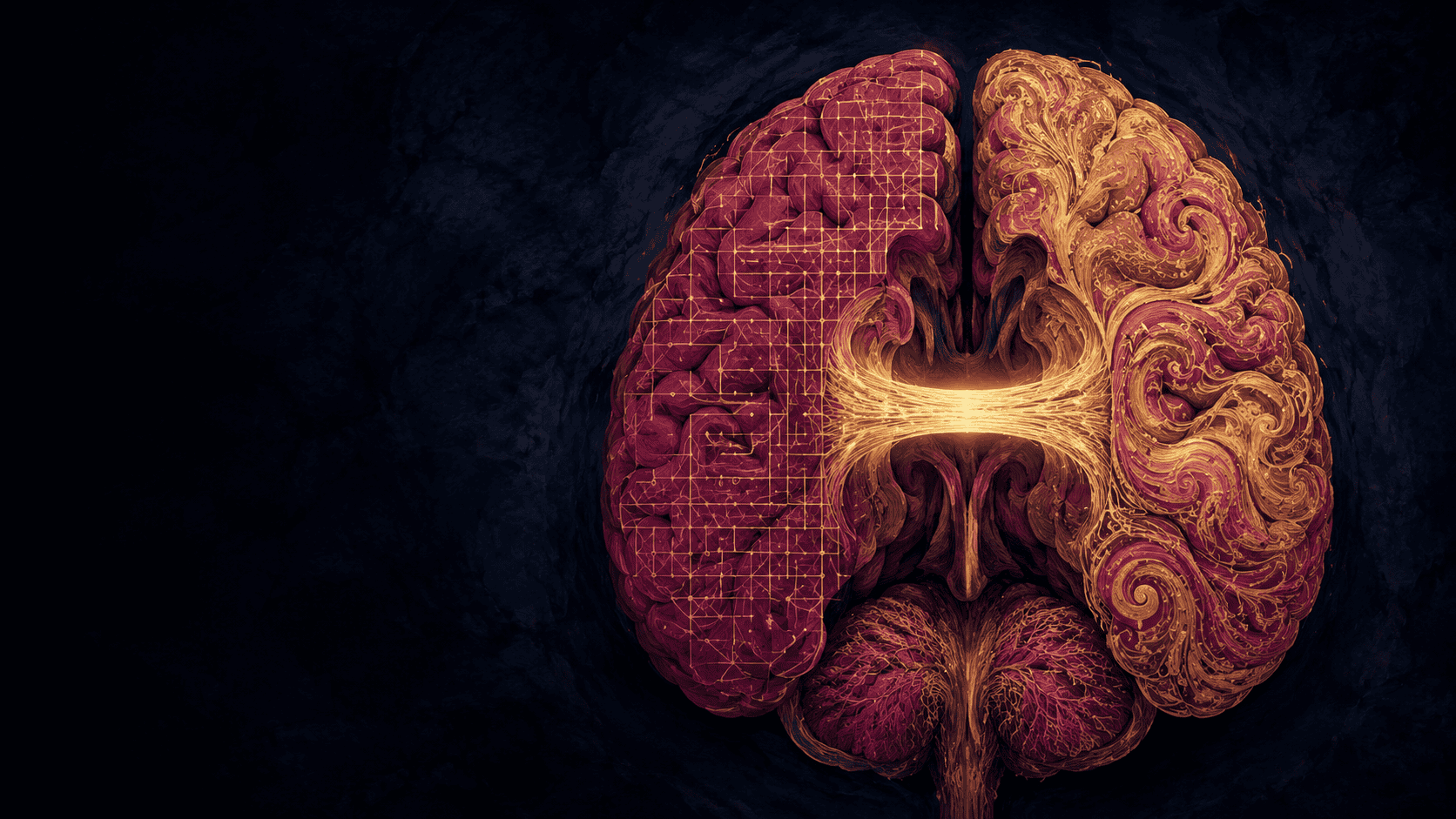
Left Brain vs Right Brain
Not "creative people vs analytical people." The actual neurological polarity, and what happens when civilizations lean too far one way.
The pop version of left brain vs right brain (analytical people use one side, creative people use the other) has been correctly dismissed by mainstream neuroscience as oversimplified. But the deeper claim, that the two hemispheres process the world in genuinely different ways and that the relationship between them shapes both individual cognition and civilizational direction, is well supported by modern neurology. Psychiatrist Iain McGilchrist's research, especially his 2009 book The Master and His Emissary, synthesized decades of neurological evidence into a framework that takes hemispheric polarity seriously as a structural feature of human cognition. The pop version was wrong. The deeper claim is real. The implications are larger than most people realize.
Left Brain vs Right Brain: Hemisphere Differences in How They Process the World
Modern neuroscience does not support the pop version of left brain vs right brain, which treats the two hemispheres as separate compartments for different kinds of thinking. The actual finding, repeatedly confirmed across split-brain studies, neuroimaging research, and lesion studies, is that both hemispheres process most kinds of information, but they do so in characteristically different styles. Four real differences are well documented.
The left hemisphere defaults to narrow, focused, target-oriented attention. It zooms in on detail and excludes context. The right hemisphere defaults to broad, vigilant, context-sensitive attention. It tracks the whole field and watches for what might be important rather than only what is already known to matter. The two styles are not interchangeable. Both are necessary. The left brain finds the worm in the grass. The right brain notices the hawk in the sky. The two attention styles are the most reliably documented hemispheric difference in modern neurology.
The left hemisphere processes faster but more shallowly. It uses pre-existing categories to assimilate new information rapidly. The right hemisphere processes more slowly but with more attention to nuance, ambiguity, and edge cases. When you encounter something genuinely new, the right hemisphere is doing the heavier lifting. When you are operating on familiar territory, the left is more efficient. The speed-vs-depth tradeoff is built into the hardware. Most people default to left-hemisphere processing for routine tasks and only engage right-hemisphere processing when something breaks the routine.
Brain lesion studies and functional imaging research consistently find that the left hemisphere is biased toward positive, approach-oriented emotions, while the right hemisphere is biased toward more cautious, withdrawal-oriented emotions and the deeper, more complex emotional registers. People with right hemisphere damage often show inappropriate optimism and detachment from emotional reality. People with left hemisphere damage often show depression and overcaution. The two hemispheres' emotional contributions are different, and a healthy emotional life requires both.
The two hemispheres relate to time differently. The left hemisphere operates on linear sequential time: planning, scheduling, tracking deadlines. The right hemisphere operates on more atemporal, immediate, gestalt time: noticing the moment, sensing the whole arc of a situation. The left brain is what makes you on time for meetings. The right brain is what notices that the meeting has gone wrong even though nothing on the agenda was missed. The complete mapping across cognition, emotion, and attention, Redacted, Chapter 19, is what McGilchrist spends a 600-page book demonstrating with neurological and historical evidence.
The pop version of left brain vs right brain was correctly criticized for treating the hemispheres as separate machines. The actual finding is more nuanced and more interesting: both hemispheres do most things, but they do them differently, and the difference matters. A person operating mostly through one hemisphere produces a recognizable cognitive signature. A civilization that does the same produces a recognizable cultural signature.
Iain McGilchrist's Master and Emissary: The Right Brain Leads
Iain McGilchrist's 2009 work The Master and His Emissary is the most ambitious synthesis of left brain vs right brain research in modern intellectual history. His thesis is that the two hemispheres are designed to work together, with the right hemisphere as the master (the broad context-tracker) and the left hemisphere as the emissary (the focused detail-handler). Three claims define the framework.
McGilchrist's central image, borrowed from a Nietzschean parable, is of a master and his emissary. The master is the broader intelligence that sees the whole context. He sends out the emissary, the more focused intelligence, to handle specific tasks. The emissary, being good at focused work, can come to believe he is the real master. When the emissary takes over, the broader context-tracking that the actual master provides is lost. The system can no longer self-correct, because it has lost its connection to the larger world. The left brain is the emissary. The right brain is the master.
McGilchrist's clinical observation is that modern Western civilization has progressively tilted toward left-hemisphere dominance over the last several centuries. The bureaucratization of life, the abstraction of finance from real economic activity, the reduction of complex phenomena to quantifiable metrics, the loss of context-sensitive judgment in favor of procedural rules. All of these are recognizable as left-hemisphere takeover. The right-hemisphere capacities (context, nuance, ambiguity tolerance, lived embodied wisdom) have been progressively devalued. The tilt is not random. It is a structural feature of the last 500 years.
The consequence of an emissary-takeover, applied at civilization scale, is a culture that becomes increasingly competent at narrow technical tasks while becoming less able to address what those tasks are for. Increasing technical sophistication paired with increasing incoherence about ends. Increasing data while decreasing wisdom. Increasing connection through networks while decreasing capacity for genuine encounter. McGilchrist's diagnosis is that the modern Western situation is recognizable as left-hemisphere takeover at the civilizational level, and the symptoms are exactly what the framework would predict. The corrective intervention at the individual level, Redacted, Chapter 19, is the same practice that the contemplative traditions have always taught, now confirmed by neuroscience as the actual fix.
McGilchrist's thesis is controversial in mainstream neuroscience for the boldness of its civilizational claim, not for its underlying neurology, which is well supported. The neurological observation is solid. The cultural extrapolation is interpretive but defensible. Taken together, the framework offers one of the few coherent accounts of why modern civilization feels structurally off in a way that more focused critiques struggle to capture.
 View on Amazon
The Master Thyself Book
The hemispheric integration the modern world is missing. And the practices that restore it.
Brain Hemispheres Map onto Political Tribes
One of the less-discussed implications of the left brain vs right brain framework is what happens when hemispheric processing styles get mapped onto political identity. The mapping is not perfect, but it is real, and recognizing it helps explain why political conflicts feel as cognitively incommensurable as they often do. The political left and right (the directions) and the brain left and right (the hemispheres) are coincidentally named, but the underlying processing styles do roughly correlate with the political tribes that have come to identify with them.
The conservative-leaning political position often prioritizes context, tradition, embodied wisdom, and skepticism toward abstract universal claims, which are right-hemisphere strengths. The progressive-leaning political position often prioritizes abstract universal principles, procedural fairness, decontextualized rights, and revisable rational frameworks, which are left-hemisphere strengths. Both styles have real cognitive virtues. Both have real cognitive blind spots. Neither is sufficient alone. Healthy political reasoning, like healthy cognition generally, requires both processing modes working together.
The metaphorical mapping of political left and right onto brain left and right has more substance than most political analysts realize. McGilchrist himself has explored some of this, though he is careful to avoid simple equivalences. The deeper claim is not that liberals "use" their left brain and conservatives "use" their right brain. The deeper claim is that the two political tribes have come to value the cognitive strengths of opposite hemispheres while devaluing the strengths of the other side. The result is two tribes that genuinely process the world differently and cannot easily translate between each other's frameworks.
The natural hemispheric difference between political tribes does not have to produce the level of polarization the modern era has produced. The polarization is being amplified, and the amplification has structural beneficiaries. When the two halves of a population are pushed into extreme versions of their natural cognitive style, neither can correct the other. The right tribe loses access to procedural fairness arguments. The left tribe loses access to embodied wisdom arguments. Both become caricatures of their own processing mode. The neuroscientific mechanism of the amplification, Redacted, Chapter 19, runs through the same attentional capture techniques that social media platforms have spent fifteen years optimizing. The mechanism amplifying this is the same divide-and-conquer pattern that operates across other social fault lines.
The political dimension of left brain vs right brain is not the central claim of the framework. It is one downstream consequence of the deeper observation that hemispheric processing styles are real and have systematic effects when they get amplified into group identities. For the broader playbook that turns natural cognitive differences into political tribal warfare, see the companion piece at Divide and Conquer. The two pages are designed to be read together.
The hemispheres are polarity made visible inside the skull.
The most striking thing about left brain vs right brain is that the polarity model is built into human neuroanatomy itself. The brain is not one undivided organ. It is two hemispheres connected by a relatively narrow bridge called the corpus callosum. The architecture of polarity is built into the hardware. This is unusual and probably not accidental.
"The corpus callosum, the bridge of communication between the two hemispheres, contains roughly 200 million nerve fibers. A significant proportion of those fibers are inhibitory."
Neurological consensus, summarized from multiple sourcesOne of the strangest facts about the corpus callosum is that a substantial portion of its fibers function to inhibit the other hemisphere, not to facilitate it. The two hemispheres are designed to communicate, but also to partially restrain each other. This is consistent with the polarity model: the two poles are not designed to merge into a single processing system. They are designed to remain distinct while staying in communication, each holding the other in check, each contributing what the other cannot.
This neuroanatomical fact is itself a kind of polarity statement made flesh. The architecture of polarity is not just a metaphysical or cultural framework. It is the hardware of human cognition. The brain is built as a working polarity model. The two hemispheres are different by design, connected by design, and partially separated by design. Treating left brain vs right brain as a metaphor misses how literal the architecture actually is.
For the broader question of whether the reality we experience is the product of this hemispheric processing or something more like a participatory medium that the hemispheres are merely interfacing with, see the companion treatment at The Illusion. The neurology and the metaphysics start touching each other once you pursue the hemispheric question far enough.
Left brain vs right brain is not "creative people vs analytical people." It is the polarity architecture of human cognition itself, hardwired into the skull, and currently running with one side dangerously dominant at civilizational scale.
The full structural breakdown, the operational implications, and the supporting evidence are covered in the book: Redacted, Chapter 19.
Master Thyself, Chapter 19Read Balance, Where Opposites Meet →Still with us?
Twelve more questions.
Each of these threads is traced to its source in the fuller investigation. If any of them pull, that is the door.
What if ...What if the pop "left brain analytical, right brain creative" version was wrong, but the deeper claim is real and well-supported?
What if attention style (narrow vs broad) is the most reliably documented hemispheric difference, and the pop version skipped it?
What if Iain McGilchrist's master-and-emissary framework is the most ambitious neuroscience-meets-culture synthesis in 50 years?
What if modern Western civilization is recognizably in a state of left-hemisphere takeover, and the symptoms match the prediction?
What if increasing technical competence paired with decreasing wisdom is the textbook signature of emissary-takeover?
What if political left and political right map onto brain hemisphere processing styles more literally than political analysts admit?
What if both tribes have real cognitive virtues and real cognitive blind spots, and neither is sufficient alone?
What if the engineered amplification of political polarization is turning natural cognitive differences into incompatible group identities?
What if the corpus callosum is a polarity model made flesh, with inhibitory fibers by design rather than by accident?
What if the two hemispheres are not supposed to merge, only stay in communication while remaining distinct?
What if hemispheric integration is one of the highest-leverage individual practices a person can do during a left-tilted civilizational moment?
What if the neurology and the metaphysics start touching each other when you push the hemispheric question far enough?