
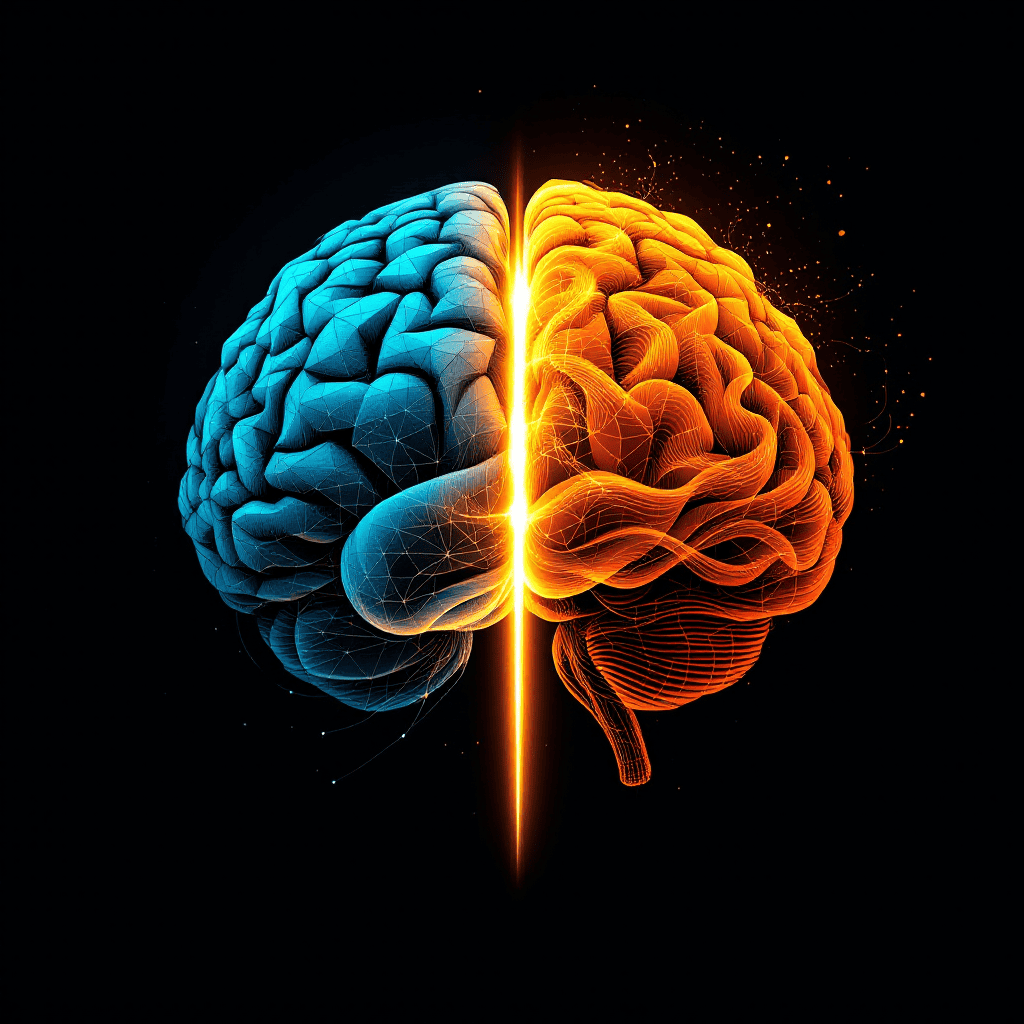
Iain McGilchrist divided brain research presents one of the most important discoveries of modern neuroscience: that the two hemispheres of your brain don’t just process information differently, they construct entirely different versions of reality. The psychiatrist and philosopher spent decades mapping how the left and right hemispheres operate as independent observers, each with its own agenda, values, and blind spots. What he found challenges everything we thought we knew about consciousness, culture, and the very nature of perception itself.
This isn’t just academic theory. McGilchrist’s work reveals why modern civilization feels so fractured, why logic and intuition seem at war, and why the rational mind often drowns out the quiet wisdom of embodied awareness. His research bridges neuroscience, philosophy, and cultural criticism, showing that hemisphere imbalance isn’t just a personal issue. It’s a civilizational crisis.
And it points directly to what ancient traditions have taught for millennia: that balance between opposites is not optional. It’s the key to becoming whole.
The Master and His Emissary: McGilchrist’s Core Thesis
In his landmark book The Master and His Emissary, McGilchrist argues that the right hemisphere is the master, the seat of holistic awareness, embodied presence, and relational intelligence. The left hemisphere is the emissary, designed to carry out focused tasks, analyze details, and manipulate the world through language and abstraction. The emissary was never meant to rule. It was meant to serve.
But somewhere in Western history, the roles reversed. The emissary took control. The left hemisphere, with its talent for categorization, mechanization, and instrumental reasoning, became the dominant voice in modern consciousness. And the master, the right hemisphere with its capacity for context, meaning, and connection, was pushed to the margins.
The consequences show up everywhere. In medicine that treats bodies as machines instead of living systems. In education that values standardized testing over creativity. In economies that reduce human beings to units of productivity. In relationships where communication becomes transactional rather than intimate. The left hemisphere sees the world as a collection of parts to be controlled. The right hemisphere sees the world as a living whole to be understood.
McGilchrist’s research builds on decades of split-brain studies and neurological case reports that reveal how each hemisphere operates when isolated. Patients with damaged or severed corpus callosums, the neural bridge connecting the two sides, demonstrate that each half generates its own interpretation of reality. The left fabricates stories to explain what it doesn’t understand. The right perceives nuance and contradiction the left cannot hold.
This division isn’t a metaphor. It’s measurable anatomy. And it has shaped the arc of human civilization in ways we’re only beginning to understand.
Left Hemisphere: The Narrow Beam
The left hemisphere operates like a spotlight. It focuses attention narrowly, isolating details from their surroundings so they can be analyzed, categorized, and controlled. This mode of attention is essential for survival. It lets you grab a tool, solve a puzzle, or sequence a plan. It gives you language, logic, and the ability to break complex problems into manageable steps.
But the left hemisphere has a fatal flaw: it doesn’t know what it doesn’t know. Its attention is so narrowly focused that it cannot perceive the context it excludes. It mistakes the map for the territory, the model for the reality, the representation for the thing itself. And when it dominates, it creates a world that feels mechanical, fragmented, and hollow.
McGilchrist traces this pattern through Western history. The Enlightenment’s embrace of pure reason. The Industrial Revolution’s reduction of nature to resource. The digital age’s replacement of embodied presence with virtual simulation. Each era amplified the left hemisphere’s voice while silencing the right’s.
The left hemisphere excels at manipulation but fails at meaning. It can dissect a poem into syllables but cannot grasp why the poem moves you. It can map every neuron in the brain but cannot tell you what consciousness is. It can build empires of data but cannot generate wisdom.
This is the world most people live in now. A world where everything is known but nothing is understood. Where information floods in but insight remains scarce. Where connection is everywhere yet loneliness epidemic. The left hemisphere promised mastery. It delivered alienation.
Right Hemisphere: The Broad Gaze
The right hemisphere operates like a floodlight. It holds attention open, perceiving wholes rather than parts, context rather than content, relationship rather than isolation. This is the hemisphere of embodied presence, emotional attunement, and intuitive knowing. It recognizes faces, reads between lines, and senses what cannot be spoken.
Where the left hemisphere asks “what can I do with this,” the right asks “what does this mean.” Where the left sees objects, the right sees beings. Where the left imposes categories, the right perceives the living complexity that categories cannot capture.
McGilchrist’s research shows that the right hemisphere is more deeply connected to the body, to emotion, and to the present moment. It doesn’t operate through abstraction but through direct experience. It doesn’t construct reality. It participates in it. This is why meditation, art, music, and nature immersion all activate the right hemisphere. They return awareness to the fullness of lived experience rather than the narrowness of conceptual thought.
Ancient wisdom traditions understood this intuitively. The polarity between logic and intuition was never meant to be resolved by choosing one side. It was meant to be integrated. The right hemisphere provides the ground. The left hemisphere works within it. Together, they create a mind capable of both depth and precision, both meaning and mastery.
But integration requires that the emissary remember its place. The left hemisphere must serve the right, not replace it. And in modern culture, that hierarchy has been inverted for so long that most people don’t even recognize what’s missing.
The Cultural Consequences of Imbalance
McGilchrist doesn’t stop at individual psychology. He maps hemisphere imbalance onto the entire arc of Western civilization. His work shows how periods of cultural flourishing, ancient Greece, the Renaissance, the Romantic era, were marked by right hemisphere engagement. Art, philosophy, and science worked together. Reason and imagination danced as partners.
But each golden age collapsed back into left hemisphere dominance. Bureaucracy replaced vision. Dogma replaced exploration. Mechanism replaced meaning. And each collapse was driven by the same pattern: the emissary seizing control, mistaking its narrow focus for the whole picture, and building systems that could measure everything except what mattered most.
The modern world is the culmination of this imbalance. Corporations treat employees as human resources. Schools treat students as test scores. Medicine treats patients as diagnostic codes. Relationships are swiped through apps. Attention is monetized by algorithms. Connection is quantified by likes. Every domain of life has been flattened into data, stripped of context, and optimized for control.
This is what happens when the left hemisphere runs the show. It builds systems that work brilliantly on paper and fail catastrophically in practice. It solves problems by creating new ones. It chases growth without asking why. It mistakes efficiency for progress and confuses information with understanding.
And because the left hemisphere cannot perceive its own limits, it pathologizes the right. Intuition becomes irrational. Emotion becomes weakness. Ambiguity becomes a problem to solve. The very capacities that make us human are dismissed as obstacles to optimization.
McGilchrist’s divided brain model explains why so many people feel disconnected from themselves, from others, and from the world. It’s not a personal failing. It’s a structural imbalance playing out at civilizational scale. The culture itself is running on one hemisphere, and the cost is showing up everywhere.
Hemisphere Imbalance and Modern Control Systems
The same imbalance McGilchrist maps in individuals and cultures also shows up in how power operates. When the left hemisphere dominates collective consciousness, populations become easier to manage. Abstract thinking detached from embodied awareness makes people susceptible to narratives that sound logical but feel wrong. Categorization makes it easy to divide populations into us versus them. Mechanistic thinking makes surveillance and control seem rational rather than dystopian.
This isn’t conspiracy. It’s consequence. Systems built by left hemisphere thinking naturally favor left hemisphere compliance. Bureaucracies reward those who follow procedures over those who question purpose. Media platforms optimize for engagement metrics over human flourishing. Education systems produce workers who can follow instructions but struggle to think independently.
The antidote is not rejecting reason or logic. That would just be another form of imbalance. The antidote is restoring the master to its rightful place. Letting the right hemisphere set the context within which the left operates. Allowing meaning to guide mechanism rather than the reverse.
This restoration begins within the individual. It requires cultivating practices that activate right hemisphere awareness. Meditation. Breathwork. Time in nature. Creative expression. Embodied movement. Genuine conversation. Anything that pulls attention out of abstract thought and back into direct experience. These aren’t luxuries. They’re survival strategies for a culture drowning in left hemisphere dominance.
And when individuals begin to restore balance, the culture shifts with them. Because the biological mechanisms of consciousness don’t operate in isolation. Fields entrain. Coherence spreads. What you embody influences what others experience. Balance is contagious.
The Interpreter Module and Manufactured Meaning
One of the most troubling findings in split brain research, work McGilchrist builds on extensively, is the discovery of what neuroscientist Michael Gazzaniga called the interpreter module. The left hemisphere doesn’t just process information. It fabricates explanations to preserve coherence, even when those explanations are completely false.
In experiments where the right hemisphere receives information the left cannot access, the left will invent a story to explain behavior it didn’t initiate. The patient acts on right hemisphere input, and the left hemisphere, unaware of the actual cause, confabulates a reason that sounds plausible. And here’s the key: the patient believes the fabrication completely. There’s no sense that the explanation is made up. It feels true.
This mechanism operates in all of us, all the time. The left hemisphere is constantly generating narratives to explain experiences it doesn’t fully understand. And those narratives shape how we perceive reality going forward. If the story says you’re a victim, you’ll find evidence everywhere. If the story says the world is dangerous, threat will dominate your attention. If the story says meaning is an illusion, you’ll dismiss the whispers of the right hemisphere as noise.
This is why ideology is so sticky. Once the left hemisphere locks onto a framework, it filters all new information through that lens. Contradictions are rationalized away. Nuance is flattened. The map becomes more real than the territory. And the right hemisphere, which perceives the complexity the left cannot hold, is ignored.
Breaking free requires recognizing when the interpreter is running. Noticing when your certainty is actually a story. Asking whether the explanation feels true in your body or only in your head. The right hemisphere knows the difference. But you have to listen.
Restoring the Master: Integration as the Path Forward
McGilchrist’s divided brain framework isn’t a call to reject the left hemisphere. It’s a call to restore proper hierarchy. The right hemisphere must lead. The left must serve. Together they form a complete intelligence capable of navigating complexity without collapsing into chaos or rigidity.
Integration doesn’t mean balance in the sense of equal time or equal weight. It means appropriate subordination. The left hemisphere’s precision is invaluable when guided by the right hemisphere’s wisdom. But precision without wisdom becomes tyranny. Mechanism without meaning becomes nihilism. Control without connection becomes domination.
This principle applies at every level. Personal development requires integrating logic and intuition, structure and flow, discipline and surrender. Relationships require balancing masculine and feminine energies, direction and receptivity, presence and action. Cultures require honoring both innovation and tradition, individual sovereignty and collective care.
The path forward is not regression to pre-rational consciousness. It’s progression to trans-rational integration. Not abandoning science, but recognizing its limits. Not rejecting technology, but refusing to let it replace embodied presence. Not dismissing logic, but subordinating it to the lived wisdom the right hemisphere carries.
The specific practices that facilitate this integration involve neurological, hormonal, and energetic protocols that quiet the left hemisphere’s dominance while activating right hemisphere capacities. These aren’t generic mindfulness techniques. They’re targeted interventions designed to shift the default mode network, synchronize hemispheric activity, and restore the master-emissary relationship at the level of brain structure itself. The timing, duration, and sequencing of these protocols determines whether they produce temporary relief or lasting transformation. Chapter 19 of Master Thyself maps the full mechanism.
McGilchrist’s Legacy and the Future of Consciousness
Iain McGilchrist divided brain research has reframed how neuroscience, philosophy, and cultural criticism understand the human condition. His work demonstrates that hemisphere function isn’t just about cognition. It’s about metaphysics. The left and right hemispheres don’t just think differently. They inhabit different worlds.
And the world the left hemisphere constructs, narrow, mechanical, abstracted from life, is the world most people now accept as reality. Not because it’s true. But because it’s all the dominant hemisphere can see. Breaking out of that prison requires awakening the right hemisphere’s capacity for holistic perception. For meaning that precedes language. For presence that transcends thought.
This awakening is already happening. Not through institutional reform, but through individual transformation. People are rediscovering embodied practices. Rejecting the tyranny of metrics. Seeking wisdom over information. Choosing connection over consumption. These aren’t lifestyle trends. They’re symptoms of the right hemisphere reasserting itself against centuries of suppression.
McGilchrist’s work provides the map. But the journey is yours. The emissary will not voluntarily step down. The left hemisphere will keep generating stories, building systems, demanding control. Integration requires conscious effort. It requires practices that activate what has been dormant. It requires recognizing that reality is not what you think. It’s what you experience when thinking stops.
The full restoration involves more than intellectual understanding. It involves the biological architecture of consciousness itself, the glands, rhythms, and fields that mediate between hemispheres and allow integration to stabilize. That architecture is explored in depth throughout the Master Thyself framework, where hemisphere balance becomes the foundation for vertical ascent through every other system of human potential.
The Iain McGilchrist Divided Brain Model in Practice
Understanding McGilchrist’s framework intellectually is one thing. Embodying it is another. The real work begins when you start noticing which hemisphere is running your experience moment to moment. Are you analyzing or perceiving? Controlling or participating? Abstracting or feeling?
Most people spend nearly all waking hours in left hemisphere dominance. Inner monologue narrating experience. Planning the next move. Judging what’s happening instead of being with it. Scrolling feeds. Checking metrics. Solving problems. This isn’t wrong. But it’s incomplete. And when it becomes the only mode, something essential dies.
Right hemisphere activation feels different. Time slows. Thoughts quiet. The boundary between self and world softens. Music doesn’t just sound good, it moves through you. Conversation stops being transactional and becomes communion. Nature stops being scenery and becomes presence. You’re not observing life. You’re living it.
This shift doesn’t require retreat from the world. It requires changing how you meet it. The left hemisphere will keep doing what it does. But when the right leads, the left’s output becomes useful rather than tyrannical. Analysis serves insight. Language expresses presence. Planning supports flow.
The specific techniques that facilitate this shift involve REDACTED, READ CHAPTER 7, where McGilchrist’s theoretical framework meets the practical protocols for neurological rebalancing. The method involves breath patterns, visual attention exercises, and somatic awareness practices designed to quiet the interpreter and open the holistic field. Timing matters. Sequence matters. Context matters. The chapter details all of it.
Polarity, Hemispheres, and the Architecture of Awakening
McGilchrist’s divided brain model maps perfectly onto the polarity framework ancient traditions encoded into every system of human development. The left hemisphere is the masculine current: focused, linear, active, penetrating. The right hemisphere is the feminine current: receptive, cyclical, relational, containing. Neither is complete without the other. And integration, what the traditions called the Middle Path, emerges when both currents flow in proper relationship.
This isn’t gendered psychology. It’s energetic architecture. Men who overdevelop left hemisphere function become rigid, disconnected, and controlling. Women who overdevelop it lose their intuitive ground and become untethered. Men who activate right hemisphere capacity become wise rather than merely intelligent. Women who do the same reclaim embodied knowing without losing discernment.
The goal isn’t androgyny. It’s wholeness. And wholeness requires that both poles express fully while the master, the right hemisphere, holds the context within which the left operates. This is the same pattern encoded in the Tree of Life, the chakra system, and every initiatory ladder humanity has ever built. Polarity at the base. Integration at the heart. Transcendence at the crown.
The biological substrate for this integration involves REDACTED, READ CHAPTER 14, which maps the triune system of consciousness: pineal as receiver, pituitary as broadcaster, heart as amplifier. When these three centers synchronize, hemisphere integration stabilizes. The left and right no longer compete. They collaborate. And the resulting coherence produces states of awareness the fragmented mind cannot access. The protocols for achieving that synchronization are detailed in full in the book.
Beyond Left and Right: The Unified Field
McGilchrist’s work points toward something even larger than hemisphere balance. It points toward the recognition that consciousness itself is not produced by the brain but mediated through it. The hemispheres are not generators of awareness but filters, each allowing a different bandwidth of reality to pass through.
The left hemisphere filters for utility, control, and survival in the immediate environment. The right filters for meaning, connection, and participation in the larger whole. When both filters operate cleanly, experience becomes multidimensional. You can think and feel simultaneously. Analyze and intuit. Act with precision while remaining present to context.
But when the left filter clogs with ideology, fear, or egoic defensiveness, reality narrows to a single channel. The right hemisphere’s signal is still there. But it can’t get through. This is what spiritual traditions called the veil, the barrier between ordinary consciousness and expanded awareness. The veil isn’t a metaphysical curtain. It’s hemisphere imbalance made neurological.
Lifting the veil requires clearing the filters. And clearing the filters requires addressing the biological, psychological, and energetic blockages that keep the left hemisphere locked in dominance. These blockages include REDACTED, READ CHAPTER 16. The chapter explores how diet, sleep, electromagnetic exposure, and emotional patterns all influence hemispheric dominance. Change the inputs, and the brain rebalances. The specific dietary interventions are outlined in full.
Once the veil thins, the unified field becomes accessible. Not as a concept but as lived reality. The separation between self and other softens. Time stops being linear. Synchronicity becomes commonplace. The interpreter quiets. And the right hemisphere’s direct knowing, what Gnostics called gnosis, what mystics called union, becomes the ground of experience.
The Political Dimension of Hemisphere Imbalance
McGilchrist’s framework also illuminates why political polarization feels so intractable. The left brain versus right brain split doesn’t just show up in individuals. It shows up in ideology. Conservative thinking, at its healthiest, reflects left hemisphere values: order, hierarchy, clear boundaries, tradition, and structured problem solving. Progressive thinking, at its healthiest, reflects right hemisphere values: inclusivity, empathy, context sensitivity, and openness to change.
Both are necessary. A culture needs structure and flow, boundaries and permeability, conservation and innovation. But when hemisphere imbalance dominates the collective, politics becomes dualism. Each side demonizes the other. Nuance disappears. And the system, run by those who benefit from division, amplifies the split.
The antidote isn’t compromise. It’s vertical integration. Rising above the binary by recognizing that both poles express partial truth. The left hemisphere’s conservative instinct protects what works. The right hemisphere’s progressive instinct adapts to what’s emerging. Together they generate resilience. Apart they generate culture war.
But integration at the political level requires integration at the personal level first. You cannot hold paradox in the world if you cannot hold it in yourself. And holding it requires REDACTED, READ CHAPTER 19, where the full polarity framework is mapped from inner masculine and feminine currents to their collective expression in culture and governance. The practices for personal integration are prerequisite to collective healing. Chapter 19 details the path.
Closing Reflection: The Return of the Master
Iain McGilchrist divided brain research is more than neuroscience. It’s a civilizational diagnosis. The modern world is sick because the emissary has usurped the master. The left hemisphere, brilliant in its domain but blind to its limits, has built a culture that values control over connection, information over wisdom, efficiency over meaning.
But the master is not gone. The right hemisphere still perceives. Still feels. Still knows. It’s just been drowned out by the noise of left hemisphere dominance. And that noise is not accidental. Systems of power thrive when populations operate from fragmented consciousness. A balanced mind is harder to control. A whole human being is a sovereign human being.
The path forward requires individual courage. It requires choosing practices that quiet the emissary and awaken the master. It requires REDACTED, READ CHAPTER 21, which maps the sevenfold path of ascent from survival consciousness to integrated awareness. Each stage builds on the last. Each requires both hemispheres working in proper relationship. And each unlocks capacities the fragmented mind cannot access.
McGilchrist showed us the map. The rest is up to you. Will you remain in the emissary’s narrow world, or will you restore the master to the throne? The choice is not intellectual. It’s embodied. And it begins the moment you stop thinking about integration and start living it.
Your brain already knows how. The master has been waiting. The only question is whether you’re ready to listen.